Anima guide 05Free
Ten places you're overpaying on card processing
Where the money leaks in your processing statement, and how to win it back.
Free guides / Payments
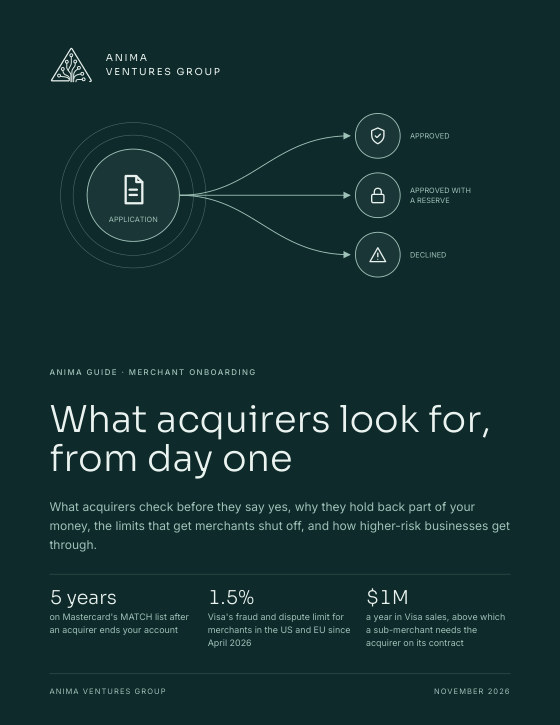
Anima guide 07 · freeAn acquirer decides in days whether you can take cards, and how much of your money it holds back. Get onboarding right and you sell sooner and keep more of each sale.
The first two pages are open. Add your first name and email to keep reading or to download the PDF.
An acquirer decides in days whether you can take cards, and how much of your money it holds back. Get onboarding right and you sell sooner and keep more of each sale.
Hand underwriters what they need on day one and skip weeks of back and forth.
Eight things to have ready: page 4.A clean record gets your reserve lowered or capped, so less cash sits with the acquirer.
How to ask for a review: page 5.Visa and Mastercard measure your fraud and disputes every month. Know where you stand.
The limits: page 6.An account closed for going over a limit can list you for five years, where other acquirers see it.
Pages 3 to 9: the review, reserves, limits, who underwrites you and card security.
Page 10: your own account, a payment facilitator or a merchant of record.
Page 11: ten yes or no questions, about two minutes. Page 12 shows where we help at your score.
Card network rules make the acquirer answer for every merchant it signs. For most businesses a decision takes a few business days. Higher-risk businesses often wait one to two weeks or longer.
Sources: Visa Acceptance Risk Standards, October 2024; approval times from industry press, June 2026, as a rough guide.
Underwriters approve what they can verify. Hand them everything on day one and you skip the back and forth.
Everyone with 25% or more, plus one person who controls the business.
Have ready: IDs and an ownership chart.Your last statements from any processor, with chargeback and refund counts.
Have ready: six months, or explain why you have none.Prices, contact details, delivery times, refund and cancel terms, all visible.
Have ready: a link to each policy page.Monthly volume and average ticket for the first year.
Have ready: numbers you can defend.Recent financial statements and bank statements.
Have ready: the last year, or since you started.Who makes or ships what you sell, and how long it takes.
Have ready: a supplier contract or invoices.Any licence your product needs, such as for pharmacy, gambling or money services.
Have ready: copies and renewal dates.The countries you sell into and where your customers are.
Have ready: a split by country.A reserve covers refunds and chargebacks that arrive after you've been paid. Each acquirer sets its own, often 5% to 15% of sales held for 30 to 180 days.
A share of each day's sales is held, then released after a set period.
The most common kind.Held until it reaches a fixed amount, then stops growing.
Ask for a cap when you sign.A lump sum paid at the start. Less common.
Usually for new or higher-risk businesses.Low disputes, proof of delivery and steady volume make the case.
Ask for a review after six clean months.Source: an acquirer's published guidance on reserves, August 2023. Reserve terms are set by each acquirer, not by the card networks.
Approval is the start. Every month the networks measure your fraud and disputes, and your acquirer watches for anything that doesn't match what you told them.
1.5% of card-not-present sales, with at least 1,500 fraud reports and disputes in a month. Fees per item above it.
1.5% with at least 100 chargebacks in a month. Fines rise each month you stay over.
3% with at least 300 chargebacks in a month. Higher fines, and termination is likely.
Sudden jumps in volume or ticket size, refunds with no sale, bursts of declines from card testing, and sales that don't match your category.
Chargebacks over 1% of Mastercard sales and $5,000 in a month, fraud of 8% or more, or breaking card data security rules.
Sources: Visa Acquirer Monitoring Program fact sheet, 2025; Visa, 9 October 2025; acquirer guides to the Mastercard chargeback programme and MATCH list, read November 2026.
Many small businesses start under a payment facilitator, which signs them as sub-merchants. The acquirer still answers for everyone. Higher-risk categories need registration with Visa before the first sale.
Sources: Visa payment facilitator and acceptance entity guides, February 2024; Visa Integrity Risk Program, in force since 1 May 2023. Mastercard has asked acquirers to scan merchant sites, including logged-in pages, before the first sale since January 2026, as reported by trade press.
Card network limits got tighter while some US paperwork got lighter. The rules on cancelling subscriptions are being rewritten.
US companies no longer report their owners to the government. Banks still collect them when you open an account.
The FTC's click-to-cancel rule is struck down. Enforcement under the older subscription law continues.
The trial period for the new fraud and dispute limits ends. Enforcement starts.
Banks verify owners when you first open an account, not again for each new account.
Work restarts on a new rule for subscriptions and free trials. Comments closed 13 April.
The merchant limit drops from 2.2% to 1.5% in the US, EU, Canada and Asia Pacific.
The exemption for US companies from owner reporting becomes final.
November 2026
A possible new rule on subscriptions and cancelling.
General information as of November 2026, not legal advice. Sources: FinCEN BOI page, updated 11 August 2026; DLA Piper, March 2026; Gibson Dunn, March 2026; Visa VAMP fact sheet, 2025.
Your acquirer asks you to prove you protect card data. The work depends on your yearly Visa payments, and whether card numbers touch your systems. Levels 1 to 3 also need quarterly scans by an approved vendor.
Visa payments in all channels. An assessor writes a yearly report on compliance.
Visa payments in all channels. A yearly self assessment questionnaire.
Visa payments online. The same yearly self assessment questionnaire.
Fewer than 20,000 online, or up to 1 million in all. Your acquirer sets what you file.
Sources: Visa merchant compliance validation levels, read November 2026; PCI SSC SAQ A and SAQ A-EP for v4.0; PCI SSC blog, 28 February 2025; PCI SSC, 20 August 2024. Mastercard sets its own levels.
Find how you take payments below. Many companies start under someone else and move to their own account as they grow.
A direct merchant account, underwritten by the acquirer, with reserve terms you agreed up front.
Start with: the eight items on page 4.Registration with the networks before your first sale, a website open to review and low disputes.
Start with: category code and licences.Fast sign-up as a sub-merchant. The facilitator underwrites you and can hold or stop your payouts.
Start with: its reserve and hold terms.Above $1 million in Visa sales, the acquirer joins your contract, so expect a fuller review.
Start with: statements ready early.You underwrite and monitor your own sub-merchants, and the acquirer answers to the networks for you.
Start with: your own underwriting policy.It is the seller to your customers, takes on cards, tax and disputes, and usually charges more per sale.
Start with: what it costs at your volume.General guidance. The right setup depends on your volume, category, countries and acquirer.
Count your yes answers, then find your score on the next page.
Every engagement starts with a free 30-minute call. Here is what usually comes next.
Also on the call, if it applies to you.
Tokenization and hosted pages that keep card numbers off your systems and your PCI scope small.
Local acquiring, currencies and when money lands in each market.
Tie every payout to its sales, fees and reserves, so nothing held goes missing.
When your model needs a licence of its own, and when a partner's covers you.
Bring your application, or the letter that declined it. Our team has run merchant services and card processing for twenty years, and knows what underwriters look for.
Add your first name and work email to open the rest here. You can download the PDF too.
We use your details to open the guide. See our Privacy policy.
Thanks, . The rest of the guide is open below. The PDF is yours to keep too.
Where the money leaks in your processing statement, and how to win it back.
When money lands on each rail, why the deposit never matches your sales, and the rules on records that match.
We work alongside your lawyers and compliance officer. Our guides are general information, not legal advice.