Anima guide 07Free
What acquirers look for, from day one
What acquirers check before they say yes, why they hold back part of your money, and the limits that get merchants shut off.
Free guides / Payments
Anima guide 05 · freeMost of a card fee is set by the networks, but the rest is yours to negotiate. Knowing which part is which is how you stop overpaying.
The first two pages are open. Add your first name and email to keep reading or to download the PDF.
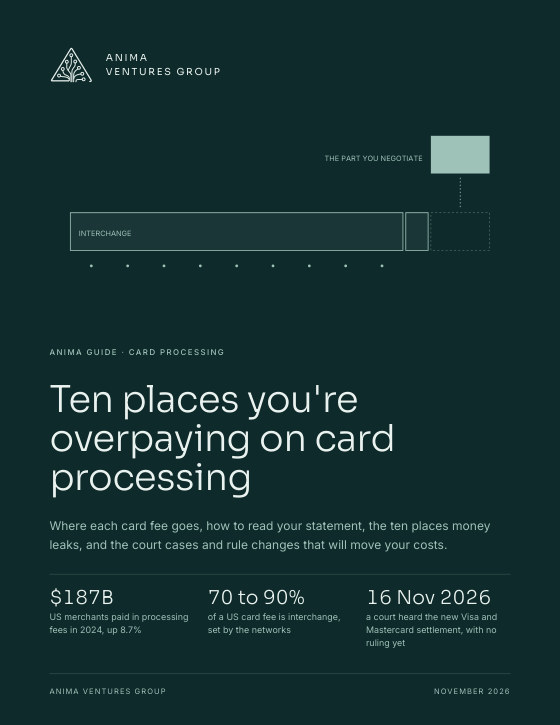
Most of a card fee is set by the networks, but the rest is yours to negotiate. Knowing which part is which is how you stop overpaying.
Minimums, statement fees and marked-up network fees add up every month.
The ten leaks are on page 4.One number, your effective rate, lets you compare any two processors.
Network tokens and card updaters keep stored cards working when cards change.
Go into renewal knowing your real costs and the rates you qualify for.
Pages 3 to 8: the fee, the ten leaks, your statement, surcharging, the rules and network tokens.
Page 9: which pricing model fits your volume.
Page 10: ten yes or no questions, about two minutes. Page 11 shows where we help at your score.
Most of each fee goes to the bank that issued the card. You can't negotiate that part, but you can make sure you pay the lowest rate you qualify for. The rest is where processors differ.
One rate for every card. Simple, and often the most expensive at volume.
Qualified, mid-qualified and non-qualified buckets. Your processor decides which bucket each card lands in.
The actual interchange, plus a fixed markup. Often the cheapest for higher volume.
Sources: Stripe, August 2026; NerdWallet, March 2026; Nilson Report, March 2025.
Fine at low volume, costly later.
Fix: price it against interchange plus.Tiered pricing can push many cards into the top bucket.
Fix: ask for each card's real interchange.Visa now gives lower business card rates only to verified merchants sending full order data. The old middle level ended on 18 April 2026.
Fix: send verified, line-item data.A monthly charge for a form you haven't filed.
Fix: finish your yearly security questionnaire.Small charges that add up every month.
Fix: ask which ones you agreed to.Auto-renewing contracts with a fee to leave.
Fix: diary the end date and negotiate before it.Network fees labelled as pass-through, with something added.
Fix: ask for network fees at cost.Rewards cards cost more to accept. The proposed settlement would let you decline them.
Fix: watch the court's ruling.Allowed on credit cards within card rules and state law.
Fix: follow the rules on the next page.Each one costs a fee, the sale and your time, and too many cost far more.
Fix: keep your dispute rate well under 1%.In November 2026 the FTC and Washington State sued a payments company over hidden fees, including a $695 early termination fee. Those are allegations, not findings.
Divide total fees by total card sales. That's your effective rate, the one number to compare between processors. Then look for the lines marked here.
Names and layouts differ between processors. Ask yours for a fee schedule that matches the statement line by line.
Card networks set one set of limits, and states set another. The stricter one wins, and debit and prepaid cards can't be surcharged.
The proposed Visa and Mastercard settlement would widen merchants' surcharge and discount rights. Until a court approves it, today's rules stand.
Sources: Visa merchant surcharging requirements; a law firm summary of state rules, October 2026. General information, not legal advice.
Two big cases could lower some fees, but neither is settled. Visa's business card changes are already in force.
New business card program replaces the top data level with rates for verified merchants.
New settlement with merchants: lower credit card rates for five years, and the right to decline premium and business cards.
The middle data level for business cards ends.
The judge gives the settlement preliminary approval.
The court agrees the Federal Reserve's debit fee cap must be redone. Today's cap stays in place for now.
Final approval hearing. About 1,000 objections are filed, and the judge has not ruled.
November 2026
If approved, the lower credit card rates are expected to take effect.
General information as of November 2026, not legal advice. Sources: Payments Dive, November 2025 and June 2026; The Spokesman-Review, 16 November 2026; Checkout.com support documentation; Global Financial Regulatory blog, November 2026.
A network token is a stand-in for the card number, issued by Visa or Mastercard. Banks trust it, and it keeps working when the card is replaced.
The bank sees a credential the network vouches for, with current card details.
Visa: 4.6% higher online approvals, late 2022.For cards saved as numbers, Visa and Mastercard updaters send new card details.
Ask your processor to turn on both.Fewer declines mean fewer retries and lost sales. Card numbers you don't keep shrink your PCI scope.
Ask if tokenized payments are priced lower.An expired or replaced card no longer stops a recurring payment.
Start with: your saved cards and renewals.Sources: Visa, What is tokenization; Visa Acceptance Solutions, token management, VisaNet data October to December 2022; Visa and Mastercard updater developer pages.
Find where you are below. Whatever your model, compare processors on one number: your effective rate.
Flat rate is simple and predictable. It often costs more as your volume grows.
Start with: your effective rate each quarter.Interchange plus shows the real cost of each card, plus a fixed markup you can negotiate.
Start with: ask for interchange plus pricing.Your processor decides which bucket each card lands in, so your costs are hard to check.
Start with: ask for each card's real interchange.Subscription or membership pricing: a monthly fee, interchange at cost and a small fee per payment.
Start with: compare the fee to your markup.General guidance. Which model wins depends on your card mix, average sale and monthly volume.
Count your yes answers, then find your score on the next page.
Every engagement starts with a free 30-minute call. Here is what usually comes next.
Also on the call, if it applies to you.
Fewer systems touching card numbers means a smaller PCI scope, and fewer fees for missed forms.
Local acquiring, currencies and when money lands in each market.
Tie every payout to the sales, fees and refunds inside it.
Launching your own cards, and what the interchange you earn depends on.
Bring your last three statements. Our team has run merchant services and card processing at scale, and knows where the markup hides.
Add your first name and work email to open the rest here. You can download the PDF too.
We use your details to open the guide. See our Privacy policy.
Thanks, . The rest of the guide is open below. The PDF is yours to keep too.
What acquirers check before they say yes, why they hold back part of your money, and the limits that get merchants shut off.
When money lands on each rail, why the deposit never matches your sales, and the rules on records that match.
We work alongside your lawyers and compliance officer. Our guides are general information, not legal advice.