Anima guide 04Free
What your bank partner will ask for
What a partner bank checks before it signs you, and what it watches every month after.
Free guides / Compliance and partners
Anima guide 03 · freeYour own licences, a partner, or both in stages. The right choice gets you live sooner, keeps your bank partner and saves years of cost you didn't need.
The first two pages are open. Add your first name and email to keep reading or to download the PDF.
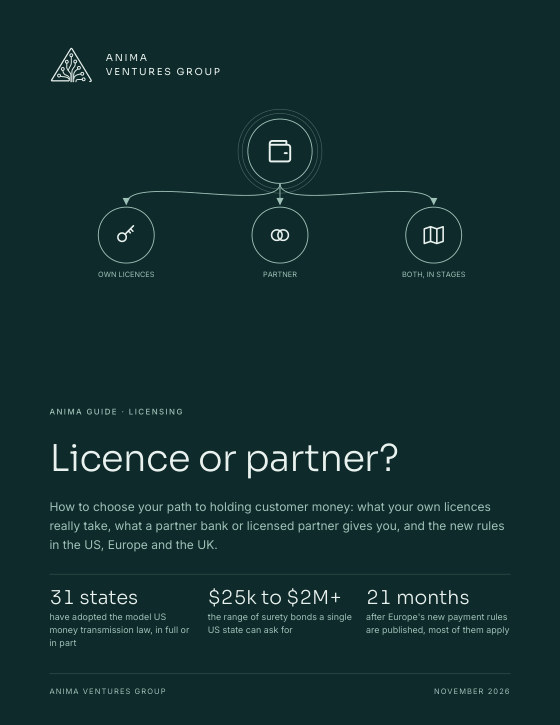
Your own licences, a partner, or both in stages. The right choice gets you live sooner, keeps your bank partner and saves years of cost you didn't need.
Launch on a partner while you prove the business, without boxing yourself in.
Know what each state and country costs before you commit capital.
What US licences take, on page 5.Show in writing why you need a licence, or why you don't.
How to write it down, on page 9.A second partner and an exit plan, agreed before you need them.
What can go wrong, on page 6.Pages 3 to 9: the paths, five questions, licences, partners, new rules and your written position.
Page 10: your own licence, a partner, or a partner first and licences later.
Page 11: ten yes or no questions, about two minutes. Page 12 shows where we help at your score.
Most teams start on a partner and add their own licences where the volume is. The right answer depends on your markets, your margin and how much control you need.
Fastest to launch. The partner's licence and bank cover you, and the partner's rules and pricing bind you.
Launch on a partner. Add your own licences in your biggest markets once volume can carry them.
Most control and margin. Years of work, capital in every state, and an exam programme to run.
If funds pass through an account you control, you are likely moving money for others. That usually needs a licence, yours or a partner's.
Acting as the agent of the person being paid can remove the need for a licence in some states. California's regulator set three conditions: you act for the payee, under a written contract made in advance, and paying you counts as paying them.
Each US state licenses separately, apart from Montana, which does not regulate money transmitters. Europe and the UK each need their own authorisation.
Your own licences mean bonds, minimum net worth, exams and staff in every market. Run the numbers against what a partner charges.
Partner banks have come under heavy scrutiny. Ask how they review fintechs, and plan for a second partner from the start.
General information as of November 2026, not legal advice. California Department of Financial Protection and Innovation opinion on the agent of the payee exemption; Montana Division of Banking.
A federal registration, then a licence in almost every state, all run through one national system. Costs vary widely from state to state.
Money services businesses register with FinCEN within 180 days of starting, and renew every two years.
Applied for, renewed and amended through the state licensing system known as NMLS.
About $250 to $10,000 per state.
About $25,000 to $2 million or more per state.
About $25,000 to $500,000 per state, held for as long as you're licensed.
From a few months to well over a year per state.
31 states have adopted the model money transmission law in full or in part. Their licensees handle 99% of reported money transmission activity, so rules are slowly becoming more alike.
Sources: FinCEN registration page; Conference of State Bank Supervisors, August and November 2026; per-state ranges from a law firm summary, June 2026.
A partner gets you live fast, but you inherit their problems. Since 2024, regulators have ordered several partner banks to tighten controls, and some can't take on new fintechs without approval.
A regulator's order can freeze new programmes overnight.
Fix: line up a second partner before you need one.When a middleware firm collapsed in 2024, customers couldn't reach their money while records were rebuilt.
Fix: keep your own ledger and reconcile it with the bank every day.Banks and fintechs each assume the other is doing it.
Fix: a contract that names who does each control.Your partner's policies decide which customers and products you can offer.
Fix: get them in writing before you build.The FDIC's 2024 proposal on records for pooled customer accounts is still pending.
Fix: build records as if it applies.Moving customers and balances takes months.
Fix: a written exit plan, agreed in the contract.Sources: enforcement summary in the National Law Review, August 2026; Consumer Financial Protection Bureau judgment of September 2025; FDIC proposed rule of 2 October 2024.
Europe has agreed new payment rules that fold e-money into payment services and change the capital you need to start. The UK has tightened how customer money is safeguarded.
Sources: Council of the EU document 8222/26, 17 April 2026, and summaries of 4 and 7 November 2026; Payment Services Regulations 2017 article 7 for today's figures; FCA, 7 August 2025.
Regulators order several partner banks to fix how they oversee fintechs. Some must get approval before adding new ones.
The FDIC proposes record rules for pooled customer accounts at banks. Still pending.
A court judgment follows the collapse of a banking middleware firm, with about $46 million for customers.
New safeguarding rules for payment and e-money firms come into force.
Bank regulators propose new guidance on how banks oversee third parties, fintechs included.
Member states adopt the new payment rules. The Commission accepts them on 3 November.
November 2026
The new rules are expected to be published. The clock starts then.
Most of the new rules apply, 21 months after publication.
General information as of November 2026, not legal advice.
Your partner bank will test it, because using you does not lower its own duties. Write a memo with your counsel: how money moves, who holds it, and whose licence you rely on.
| Task | You | Partner bank or licence holder | Your vendors |
|---|---|---|---|
| Customer checks | Collect and review | Sets the rules, approves | Identity checks |
| Sanctions screening | Screen every day | Oversees, can stop | Screening lists |
| Suspicious activity | Spot and escalate | Decides and files | Monitoring tool |
| Holding the money | Never | Holds it for customers | None |
| Ledger and daily match | Keep and match | Checks against its books | Ledger software |
| Complaints and disclosures | First answer, drafts | Approves, handles escalations | None |
Who does what is a typical split; your contract decides. Unsure of your position? FinCEN can rule on your actual facts. Not legal advice. Sources: Interagency Guidance on Third-Party Relationships, 2023; FinCEN, administrative rulings.
Find your business below. Most companies start on a partner and add licences where the volume is.
A licensed partner. You build the product; the partner holds the money and the licence.
Start with: the partner's rules, in writing.Partner first, then your own licences where most of your volume is.
Start with: licence costs in your top three states.Your own licences, a tested compliance programme and bank accounts in your own name.
Start with: a two-year licensing budget.Agent of the payee or a similar exemption, confirmed by counsel and written down.
Start with: a memo from your counsel.Plan each separately. US licences don't count there, and Europe's rules are changing.
Start with: where you would be authorised.Expect slower approvals and tighter rules. Line up a second partner now.
Start with: the exit terms in your contract.General guidance. The right path depends on your flow, your markets and your margin.
Count your yes answers, then find your score on the next page.
Every engagement starts with a free 30-minute call. Here is what usually comes next.
Also on the call, if it applies to you.
What a sponsor bank checks before it says yes, and every year after.
A ledger that matches the bank every day, so you know who owns every dollar.
Screening your partner bank will accept, set up before you launch.
Launching cards on a partner's licence, and what you own in the programme.
Bring your flow and your markets. Our team has held money services and e-money licences, built the compliance behind them, and processed billions in payments across our careers.
Add your first name and work email to open the rest here. You can download the PDF too.
We use your details to open the guide. See our Privacy policy.
Thanks, . The rest of the guide is open below. The PDF is yours to keep too.
What a partner bank checks before it signs you, and what it watches every month after.
We work alongside your lawyers and compliance officer. Our guides are general information, not legal advice.