Anima guide 03Free
Licence or partner?
When to apply for your own licence, when to partner, and what each path really costs.
Free guides / Compliance and partners
Anima guide 04 · freeA partner bank's review decides when you can launch and how fast you can grow. Show up prepared and the review becomes a checklist, not a negotiation.
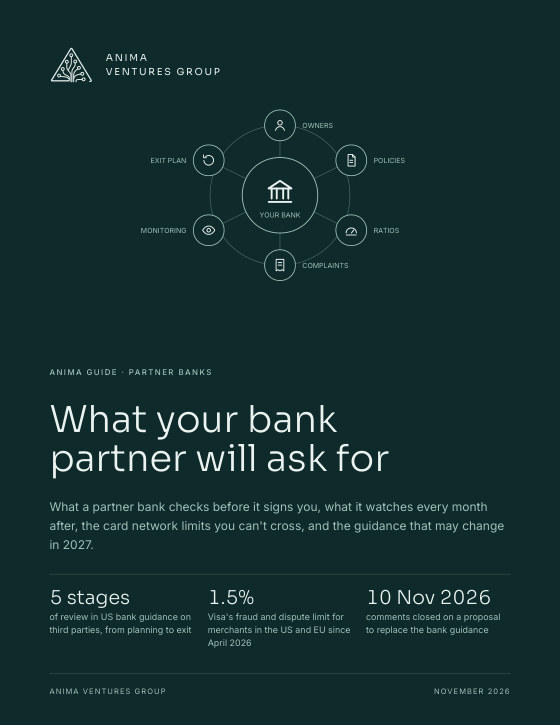
The first two pages are open. Add your first name and email to keep reading or to download the PDF.
A partner bank's review decides when you can launch and how fast you can grow. Show up prepared and the review becomes a checklist, not a negotiation.
Banks move faster with a fintech that sends a complete file the first time.
The full document list is on page 8.Know the monthly numbers and card network limits your bank watches for you.
Keep your file current, so reviews and exam findings don't turn into a scramble.
A file that is ready for one bank is most of the way to the next one.
Pages 3 to 8: the review stages, your file, card limits, higher risk, the rules and the documents.
Page 9: what a ready file looks like for a first bank, a second bank, a yearly review or an exam finding.
Page 10: ten yes or no questions, about two minutes. Page 11 shows where we help at your score.
US banks follow guidance from their regulators on overseeing outside companies. For a fintech partner, it covers the whole relationship, from the first meeting to the day it ends.
Sources: Interagency Guidance on Third-Party Relationships, June 2023; FDIC FIL-3-2012; FFIEC BSA/AML Examination Manual.
Banks move faster with a fintech that shows up prepared. Each of these answers a question the bank will ask anyway.
Every owner above your threshold, with IDs and background checks done.
Have ready: an org chart down to the people.Your products, customers, countries and how each could be abused.
Have ready: one per product line.A named, qualified person with the authority and budget to act.
Have ready: their CV and reporting line.An outside review of your anti-money laundering programme.
Have ready: the last report and your fixes.Expected volume by customer type, so the bank can spot anything odd.
Have ready: 12 months, by month.Every complaint, from every channel, with how it was closed.
Have ready: six months of history.Every vendor that touches customers or money, and their subcontractors.
Have ready: the list and your reviews.How customers and balances move if the relationship ends.
Have ready: a written plan with owners.If you take card payments, Visa and Mastercard measure your fraud and disputes every month. Cross a line and you pay fees, and your bank or acquirer may drop you.
Fraud reports plus disputes, divided by settled transactions. Above the limit, fees of about $8 per item apply.
Merchants an acquirer terminates go on Mastercard's MATCH list, which acquirers check against the past five years.
Sources: Visa Acquirer Monitoring Program fact sheet, 2025; Merchant Risk Council, 1 April 2026; Mastercard limits as published by acquirers, July 2026; Mastercard MATCH developer page.
Visa asks acquirers to register merchants in certain categories and hold them to tighter controls. A bank partner applies the same lens to you.
Adult content, dating and escort services, gambling, pharmacies
Crypto purchases, file storage lockers, games of skill
Trading platforms, telemarketing, subscriptions and free trials, cross-border tobacco
Source: Visa Integrity Risk Program, in effect since 1 May 2023, as summarised by LegitScript, November 2023.
Enforcement against partner banks has eased since 2024, but the bar for fintechs has not dropped. A proposal would replace the 2023 guidance with a shorter, principles-based version.
Guidance on third-party relationships sets the five stages banks follow today.
Several partner banks receive enforcement orders. Some can't add fintechs without approval.
New fraud and dispute limits start, with a single combined ratio.
One of the 2024 orders against a partner bank is lifted after 22 months.
The merchant limit drops from 2.2% to 1.5% in the US, EU, Canada and Asia Pacific.
Proposal to replace the 2023 guidance and withdraw the 2024 statement on bank and fintech deposit programmes. Comments closed 10 November.
November 2026
Final guidance. Until then the 2023 guidance applies.
General information as of November 2026, not legal advice. Sources: OCC news release 2026-77; Hunton, September 2026; Banking Dive, December 2024 and November 2025.
Each bank sends its own request list, but four security policies, a core set of documents and insurance come up on almost every one.
How you protect data and systems, who owns the programme and how often you review it.
Have ready: the policy and its last review.Who does what when something breaks, and when and how you tell the bank.
Have ready: the plan and your last test.How fast you resume service and recover data after an outage.
Have ready: recovery times and the last test.Who can reach which systems and customer data, and how you remove access.
Have ready: your last access review.Source: Interagency Guidance on Third-Party Relationships, June 2023, due diligence factors. Request lists, insurance types and amounts differ by bank.
Find your stage below. Each one asks for the same file, with a different focus.
A complete file, a named compliance officer and policies approved before the first call.
Start with: the document list on page 8.Your file reused, fresh due diligence answered, and a plan for how money splits between banks.
Start with: your first bank's last review.Updated numbers, policies reviewed this year and every open finding closed or on track.
Start with: last year's list of findings.A written fix plan with owners and dates, and proof of progress you can show the bank.
Start with: one named owner per finding.General guidance. Each bank sets its own requirements and timelines.
Count your yes answers, then find your score on the next page.
Every engagement starts with a free 30-minute call. Here is what usually comes next.
Also on the call, if it applies to you.
When you need a licence of your own, and when a partner bank is enough.
Screening customers and payments, and the records a bank asks to see.
Fewer systems touching card numbers means a smaller PCI scope. Tokenization is how you get there.
Records that match the bank's, every business day.
Bring your last review letter, or the questions your bank just sent. Our team has spent twenty years building and running regulated payments companies, compliance included.
Add your first name and work email to open the rest here. You can download the PDF too.
We use your details to open the guide. See our Privacy policy.
Thanks, . The rest of the guide is open below. The PDF is yours to keep too.
When to apply for your own licence, when to partner, and what each path really costs.
We work alongside your lawyers and compliance officer. Our guides are general information, not legal advice.