Anima guide 02Free
Building payments products with AI
Where AI helps, where a person must stay in charge, seven costly traps and a safe pattern.
Free guides / AI
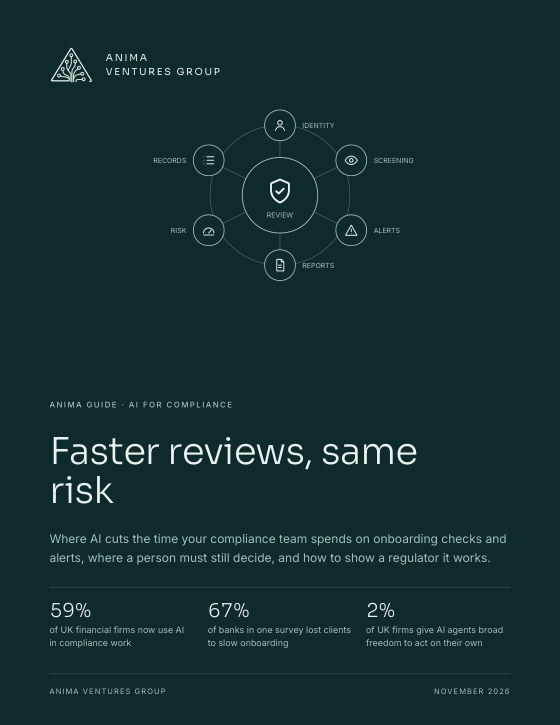
Anima guide 10 · freeAI can take much of the reading, matching and writing off your compliance team. Done well, you onboard customers sooner and can show a regulator every decision.
The first two pages are open. Add your first name and email to keep reading or to download the PDF.
AI can take much of the reading, matching and writing off your compliance team. Done well, you onboard customers sooner and can show a regulator every decision.
AI reads documents and clears obvious mismatches, so a person only sees the hard cases.
Where AI saves the most: page 3.Group, enrich and rank alerts so analysts start with the few real ones.
How to triage alerts: page 4.Tested tools, a named owner and a log of every decision.
Six steps to prove it: page 7.Saying no, confirming a sanctions match and filing a report stay with a person.
Sanctions matches: page 9.Pages 3 to 9: checks, alerts, who owns what, deepfakes, proof, rules and sanctions.
Page 10: which review steps AI can take, step by step.
Page 11: ten yes or no questions, about two minutes. Page 12 shows where we help at your score.
A typical identity check runs five steps. AI can do most of the reading and matching. The hard cases, and the decision to say no, stay with a trained person.
General guidance. Your own risk assessment sets which cases need a person.
Transaction monitoring raises far more alerts than real cases. AI can group, enrich and rank them so analysts spend their time on the few that matter.
One customer, one case, not twenty separate alerts.
Past cases, linked accounts and public records, gathered before the analyst opens it.
AI writes a first draft of the case notes, and the analyst edits it.
Closing alerts without a person is where regulators look first.
Illustrative flow. Measure your own alert volumes before and after, and keep the numbers.
UK regulators found that 80% of firms already run AI agents, but only 2% let them act freely. The same caution fits compliance.
Source: Bank of England and FCA, Artificial intelligence in UK financial services 2026, 26 October 2026.
US regulators warned in November 2024 that more and more fraud reports describe AI-made identity documents used to get past checks. One check is no longer enough.
Fonts, security features and data that don't add up.
Fix: use a tool that checks more than the photo.Ask for movement in real time, not a still picture.
Fix: test liveness against injected video, not just masks.Emulators, virtual cameras and the same device behind many accounts.
Fix: add device signals to the risk score.Does the phone, email, address and history fit the person?
Fix: compare against data sources you trust.A fake account often looks clean on day one.
Fix: watch behaviour after onboarding.International standard setters recommend layered checks and AI-supported reviews.
Fix: never let one check decide alone.Sources: FinCEN alert FIN-2024-Alert004, 13 November 2024; FATF guidance on digital identity, March 2020; FATF horizon scan on AI and deepfakes, as summarised January 2026.
Regulators in the US, UK and EU expect the same things from AI as from any model: know what it does, test it, watch it, and keep a person accountable.
Write down each AI tool, what it decides or drafts, and who owns it.
Run it on past cases where you know the right answer, and keep the results.
Name who signs off on each kind of decision.
Record what the AI said, what the person decided and why.
Check each month that results still match the tests.
Ask how their models are tested and what data they use.
Sources: Federal Reserve SR 26-2, 17 April 2026; FinCEN proposal, 7 April 2026; FCA, December 2025; EU AI Act and Regulation (EU) 2026/1744.
Several 2024 rules were withdrawn or replaced in 2025 and 2026. Check the current version before you build on any of them.
An alert on deepfake identity documents in fraud schemes.
Banned AI practices take effect under the AI Act.
Withdraws its guidance on explaining credit decisions made by complex models.
The first firms join its live AI testing service.
An executive order on a national approach to AI rules.
Proposes new anti-money laundering program rules, replacing a 2024 proposal.
New model risk guidance, including for anti-money laundering models.
Changes to the AI Act take effect and move the high-risk dates.
November 2026
High-risk AI rules begin, including credit scoring.
Final anti-money laundering program rule.
General information as of November 2026, not legal advice. Sources: FinCEN; CFPB withdrawn guidance page; FCA; White House; Federal Reserve; EUR-Lex.
Most screening hits turn out to be someone else. The work is clearing those fast, stopping the real ones, and keeping a record a regulator can follow.
Sources: OFAC FAQ 5 on screening matches and 31 CFR 501.603 and 501.604; OFAC reminder on the 2026 Annual Report of Blocked Property; OFAC final rule on recordkeeping, in force 21 March 2025. Other countries set their own rules.
Find each step of your reviews below. Start where the reading is heaviest and the risk of a wrong call is lowest.
Reading IDs and company papers, filling in the case and spotting what's missing.
Start with: AI fills, a person checks.Name hits that are clearly someone else, with the reason written down.
Start with: partial matches only.Group, enrich and rank alerts. Closing high-risk ones stays with a person.
Start with: AI ranks, analysts close.A first draft of the case notes, which the analyst edits and signs.
Start with: drafts on low-risk cases.Saying no, filing a report and confirming a sanctions match stay with a named person.
Start with: name who signs each one.AI gathers updates and flags changes. A person approves the new risk rating.
Start with: the highest-risk customers.General guidance. Your own risk assessment, regulators and bank partners set where a person must decide.
Count your yes answers, then find your score on the next page.
Every engagement starts with a free 30-minute call. Here is what usually comes next.
Also on the call, if it applies to you.
What a sponsor bank checks in your compliance before it says yes, and every year after.
When your model needs a licence of its own, and the programme that comes with it.
Choosing lists, tuning matches and testing your screening before an examiner does.
Screening wallets and on chain payments, and matching them to your books.
Bring your onboarding flow and a week of alert numbers. Our team has built and run the compliance behind licensed payments companies, and builds AI tools for it.
Add your first name and work email to open the rest here. You can download the PDF too.
We use your details to open the guide. See our Privacy policy.
Thanks, . The rest of the guide is open below. The PDF is yours to keep too.
Where AI helps, where a person must stay in charge, seven costly traps and a safe pattern.
Where AI coding tools help, where people must stay in charge, and what card security rules expect from code a machine wrote.
We work alongside your lawyers and compliance officer. Our guides are general information, not legal advice.