Anima guide 09Free
Ship faster with AI, and stay in control
Where AI coding tools help, where people must stay in charge, and what card security rules expect from code a machine wrote.
Free guides / AI
Anima guide 02 · freeAI can take hours out of onboarding, disputes and matching. Decide early which jobs it runs, which a person keeps, and how you prove it.
The first two pages are open. Add your first name and email to keep reading or to download the PDF.
AI can take hours out of onboarding, disputes and matching. Decide early which jobs it runs, which a person keeps, and how you prove it.
Document reviews, dispute drafts and payment matching, done in minutes and checked by your team.
Card data in prompts, agents with no limit, models nobody tests.
Seven traps and their fixes, on page 4.Show who approved what, and why, for every decision that touches money.
The five-step pattern, on page 5.A named owner for each decision AI helps with but must not make alone.
The table, on page 8.Pages 3 to 8: the split, the traps, the safe pattern, the rules, agents that pay and who signs what.
Page 9: which AI jobs you can run now, and which should wait.
Page 10: ten yes or no questions, about two minutes. Page 11 shows where we help at your score.
AI is very good at the slow, paper-heavy work around payments. It should not have the last word on anything that moves money, closes an account or answers to a regulator.
Where the line sits is a business decision. Write it down, and make your software enforce it.
An AI tool that sees card numbers is in your PCI scope.
Fix: give the model tokens, never card or bank details.One bad instruction can spend real money.
Fix: own credentials, own permissions and a hard cap per agent.Banks and auditors will ask why a payment went through.
Fix: log inputs, model version, output and who signed off.Models can state a wrong number fluently.
Fix: test on real cases, and again after every model change.An invoice or ID upload can carry text that steers your AI.
Fix: documents are data and never trigger a payment alone.AI calls add up across millions of transactions.
Fix: know what each task costs and what it saves.Credit, fairness and data rules still apply when a model decides. EU high-risk rules for AI credit scoring start on 2 December 2027.
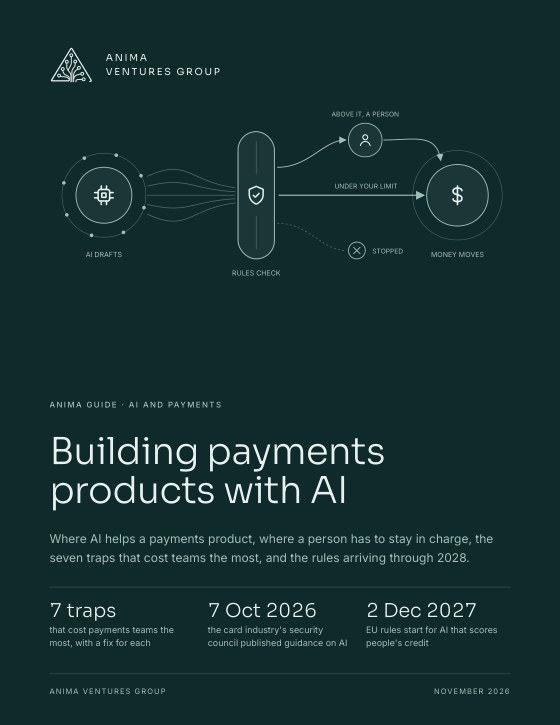
Fix: map the rules for each market before launch.The AI proposes. Your own rules check it. A person approves when the stakes are high. Then money moves, and every step leaves a record.
Tokens in, tokens out. Card numbers, bank details and keys stay outside what an AI can read.
Limits, sanctions results and policies are checked by your software, not by a model, and nothing skips it.
Above your limit, a person signs off. Below it, payments go through on their own.
Who asked, what the model saw and said, which rules ran and who approved, kept like any payment record.
Card security standards already reach AI systems. Europe's AI Act phases in through 2028. Your payments, credit and privacy rules apply the whole time.
The AI Act's bans on certain AI uses apply.
The Digital Omnibus enters into force and moves the AI Act's high-risk deadlines later.
The PCI Security Standards Council publishes guidance on AI in payment environments. It recommends human approval for agent actions involving card data in the clear, and keeping credentials out of what an AI can see.
November 2026
High-risk rules start for AI that scores people's credit: risk management, data quality, human oversight and records.
High-risk rules start for AI built into products that are already regulated.
General information as of November 2026, not legal advice. Sources: Regulation (EU) 2026/1744 as summarised by the AI Act Explorer and Morgan Lewis, June 2026; PCI SSC press release of 7 October 2026 and Help Net Security, 9 October 2026.
Card networks and payment companies are building ways for AI agents to pay for people. They share one idea: an agent gets limited, provable permission, never the customer's real card.
Agent-specific card tokens, with a signed record of what the person asked for
Card tokens, and a way for merchants to recognise trusted agents
From Stripe and OpenAI. One-time tokens limited to one merchant and one amount
A way for agents to prove a person authorised a payment
From Coinbase. Small stablecoin payments inside ordinary web requests
Stages change quickly. Based on a public comparison published in March 2026.
AI can gather the facts and draft the answer. A named person still makes these calls, and the record shows they did.
| Decision | AI can | A named person | Why it matters |
|---|---|---|---|
| Suspicious activity report | Gather the facts, draft the story | Your anti-money laundering officer | US money businesses file within 30 days and can't tell the customer |
| Sanctions hold or release | Rank matches, collect proof | A trained sanctions analyst | Blocked or rejected payments go to OFAC within 10 business days |
| Credit refusal or lower limit | List the main factors | Your credit lead | US lenders must give specific reasons, AI or not |
| Closing an account or freezing funds | Flag it and build the case | Your head of risk | A customer loses access to their money |
| Letter to a regulator or bank | Draft it from your records | Your compliance head or CEO | It is your company's word |
| Changing a live model | Run the tests, compare results | Product and risk, together | Outcomes can change with no code change |
Not legal advice. Sources: FinCEN, suspicious activity reports for money services businesses; OFAC reporting FAQs; Regulation B, 12 CFR 1002.9.
Find your business below. Start where AI drafts and a person decides. Wait where AI would decide alone.
Run now: dispute drafts and payment matching. Wait: refunds or payouts with no person checking.
Start with: drafts for chargeback responses.Run now: document reviews that flag gaps. Wait: approvals or refusals made by AI alone.
Start with: a gap check on each new file.Run now: alert sorting and case summaries. Wait: clearing a sanctions match or filing a report.
Start with: case summaries for your analysts.Run now: reconciliation, report drafts and invoice matching. A person checks before anything is booked.
Start with: one month of matching, checked by hand.Run now: agents with their own token, a hard cap and a person above it. Wait: open spending.
Start with: one agent, one merchant, one limit.Wait on AI that decides. Use AI that explains, and plan for EU credit rules from 2 December 2027.
Start with: specific reasons for every refusal.General guidance. What you can run now depends on your licences, your partners and the markets you serve.
Count your yes answers, then find your score on the next page.
Every engagement starts with a free 30-minute call. Here is what usually comes next.
Also on the call, if it applies to you.
Fewer systems touching card numbers means a smaller PCI scope. Tokenization is how you get there.
Screening that catches real matches without drowning your team in false ones.
Matching every deposit to the sales, fees and refunds inside it.
What a sponsor bank checks before it says yes, and every year after.
Bring the AI feature you're planning, or the one that worries you. Our team has spent twenty years building payment products and the technology behind them.
Add your first name and work email to open the rest here. You can download the PDF too.
We use your details to open the guide. See our Privacy policy.
Thanks, . The rest of the guide is open below. The PDF is yours to keep too.
Where AI coding tools help, where people must stay in charge, and what card security rules expect from code a machine wrote.
Where AI cuts the time spent on onboarding checks and alerts, where a person must still decide, and how to show a regulator it works.
We work alongside your lawyers and compliance officer. Our guides are general information, not legal advice.