Anima guide 01Free
On and off ramps that don't get stuck
The five handoffs between bank and stablecoin, where ramps break, and the rules now in force.
Free guides / Stablecoins
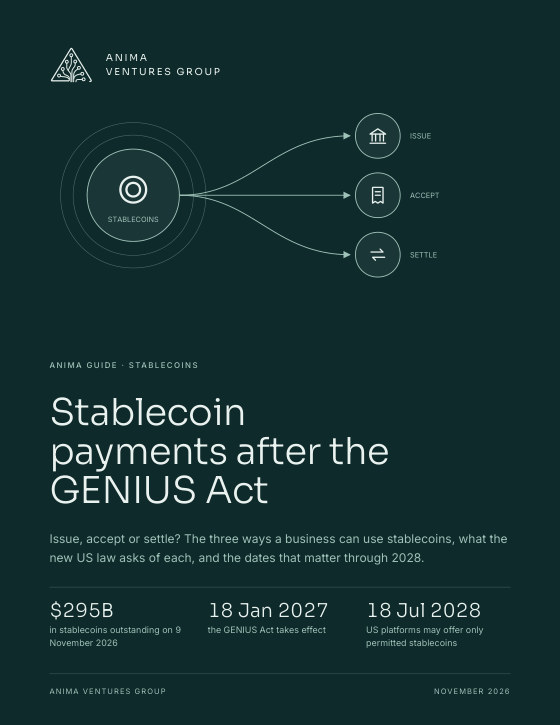
Anima guide 06 · freeMost businesses don't need to issue a coin. Picking the right setup decides your licence, your partners and how fast you can start.
The first two pages are open. Add your first name and email to keep reading or to download the PDF.
Most businesses don't need to issue a coin. Picking the right setup decides your licence, your partners and how fast you can start.
Stablecoins settle around the clock, weekends included, so money doesn't wait for the bank.
Five ways to use stablecoins, from accepting through a processor to issuing your own.
All five side by side, on page 8.Each setup needs a different licence or partner. Find out before you build.
The law takes effect in January 2027. From July 2028, US platforms may offer only permitted coins.
Pages 3 to 8: the three uses, the issuer rules, the market, the rules and the five setups.
Page 9: which of the five setups you are in, and where to start.
Page 10: ten yes or no questions, about two minutes. Page 11 shows where we help at your score.
Most businesses don't need to issue a stablecoin. Accepting or settling in one can bring faster, cheaper money movement with far less work.
Your own coin. A licence, full reserves, monthly reports and a long road. For banks and large payment companies.
Move money between you, partners and banks in stablecoins. Faster cross-border settlement, through a provider.
Let customers pay in stablecoins through your processor, and receive dollars. The quickest start.
The law sets who may issue, what backs each coin and what holders are owed. The OCC's final rule adds detail for the issuers it supervises.
Subsidiaries of insured banks, nonbanks approved by the OCC, and state-qualified issuers.
Cash, deposits, Treasuries maturing within 93 days, and certain repos and money market funds.
At least 5% in demand deposits or Fed balances, and no more than 40% with one counterparty.
Holders can turn coins back into dollars on that timetable.
At least $5 million in capital, plus 12 months of running costs in liquid assets.
Examined by a registered accounting firm and signed off by the CEO and CFO.
Issuers can't pay yield, and the OCC gave no exception for rewards programmes.
Smaller issuers can stay with a state regulator. Above $10 billion, federal oversight applies.
Reserves sit outside the issuer's bankruptcy, and holders are paid before anyone else. A payment stablecoin is not a security or a commodity under the law.
Sources: Greenberg Traurig and Willkie, July 2025; Morrison Foerster, 28 October 2026; Mayer Brown, 4 November 2026. General information, not legal advice.
You don't need your own coin to use stablecoins. Card networks now settle with banks in stablecoins, and processors let merchants accept them and receive dollars.
Settles with banks in stablecoins on 9 blockchains, at a $7 billion annual run rate
Settles card payments on-chain in six stablecoins across 8 blockchains
US businesses accept USDC, USDP and USDG and are paid in dollars, up to $10,000 a payment
Sources: Visa, 29 April 2026; Mastercard, 3 June 2026; Stripe documentation, November 2026. Stages change quickly.
Stablecoins in circulation peaked at about $315 billion in May 2026. By the 2028 deadline, every coin offered on a US platform will need to come from a permitted issuer.
US accounting standard setters proposed in August 2026 that some stablecoins could count as cash equivalents, if holders can redeem them directly at par and reserves are segregated. Not final.
From 2026, brokers report digital asset sales on a new IRS form, with an optional rule to skip small stablecoin totals of $10,000 a year or less.
Market data from DefiLlama via Stablecoin Insider, 9 November 2026. Sources: Deloitte on the FASB proposal, 19 August 2026; IRS Form 1099-DA instructions, 2026.
The OCC has its final rule. Other agencies, including the FDIC, the Federal Reserve and Treasury, have only proposed theirs.
The GENIUS Act becomes law.
The FDIC, Treasury, FinCEN, OFAC and the NCUA propose their rules, including anti-money laundering and sanctions rules for issuers.
Two proposals published. Comments are due around 30 November.
Final rule for the issuers it supervises, effective 18 January 2027.
November 2026
The law takes effect.
Digital asset platforms serving US customers may offer only stablecoins from permitted issuers.
General information as of November 2026, not legal advice. Sources: OCC Bulletin 2026-50; Willkie, October 2026; Mayer Brown, November 2026.
Who holds the coins, who turns them into dollars and what you typically need. The further down the list, the more you take on yourself.
The processor holds and converts. You get dollars. Needs: a processor that takes them.
You or a custodian hold. The issuer or an exchange converts. Needs: a custodian.
A provider holds, sends and converts. Needs: often a licensed partner or a licence.
You or a custodian hold for customers. Needs: custody and transmission licences, or partners.
You hold the reserves and redeem coins for dollars. Needs: approval as a permitted issuer.
Under the GENIUS Act, custody of customers' coins needs a supervised custodian.
Money transmission rules differ by state and country. Check each place you serve.
Sources: GENIUS Act, sections 3 and 10; FinCEN guidance FIN-2019-G001 on virtual currency, May 2019. General information, not legal advice.
Find what you want to do below. If you do two, plan for the heavier one.
Your processor takes the coins and pays you dollars. Refunds follow a clear policy, since there are no chargebacks.
Start with: which coins and chains it takes.Coins from permitted issuers, a custodian you trust and a plan for a day below a dollar.
Start with: agree the accounting with auditors.Every payee screened for sanctions, and every payout tied to an invoice or order.
Start with: a licensed payout partner.Customer coins kept apart from yours and matched every day, with a supervised custodian.
Start with: a custody partner, before you build.Full reserves, monthly reports, redemption within two business days and an approval to issue.
Start with: an honest look at cost and time.Many companies combine two setups, such as accepting and paying out. Plan the licences together.
Start with: list every flow of coins you touch.General guidance. Licence needs vary by state and country, and by how your partners are licensed.
Count your yes answers, then find your score on the next page.
Every engagement starts with a free 30-minute call. Here is what usually comes next.
Also on the call, if it applies to you.
When you need a licence of your own, and when a partner is enough.
Screening wallets and counterparties, and keeping the records.
Matching on chain money to your bank and your books.
What a sponsor bank checks before it says yes to stablecoin flows.
Bring the use you have in mind, whether that's accepting, settling or issuing. Our team has spent twenty years in payments, from card processing and issuing to stablecoins, money services and e-money licences, worldwide.
Add your first name and work email to open the rest here. You can download the PDF too.
We use your details to open the guide. See our Privacy policy.
Thanks, . The rest of the guide is open below. The PDF is yours to keep too.
The five handoffs between bank and stablecoin, where ramps break, and the rules now in force.
We work alongside your lawyers and compliance officer. Our guides are general information, not legal advice.